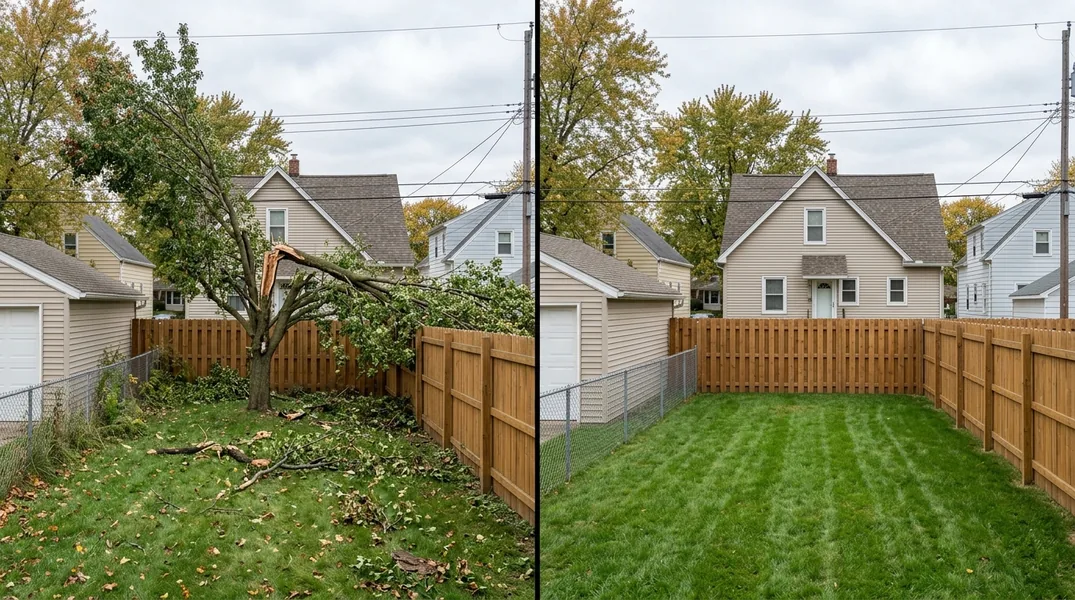
Understanding the Difference: Tree Trimming vs. Tree Removal
When you look out at your yard and see a tree that's overgrown, diseased, or damaged, your first question is probably simple: does it need to come down, or can it be saved? This is one of the most common decisions homeowners in South Bend face, and the answer isn't always obvious without professional guidance.
Tree Trimming & Pruning is a maintenance practice that removes dead, diseased, or overgrown branches to improve the tree's health, appearance, and safety. It's a way to preserve your tree while addressing specific problems. Tree Removal, on the other hand, is a more serious intervention where the entire tree is taken down. This is typically necessary when a tree poses a safety risk, is severely diseased, or has reached the end of its life. The key difference is that trimming works to save and improve your tree, while removal eliminates it entirely. Understanding when each approach is appropriate can save you time, money, and regret.
Signs Your Tree Needs Trimming, Not Removal
A healthy tree often just needs regular trimming to thrive. If your tree is structurally sound but has some problem branches or overgrown limbs, trimming is almost always the right choice. Look for trees with branches that are crossing each other, rubbing together, or growing inward toward the trunk. These branches can damage the tree's overall structure and should be removed. Similarly, if you notice dead wood, broken branches from storm damage, or limbs hanging over your roof or power lines, trimming can address these hazards without sacrificing the entire tree.
Trees that have minor disease or pest problems are also good candidates for trimming rather than removal. For example, if only a portion of the tree is affected by disease, an arborist can remove the compromised branches and allow the healthy parts to continue growing. Young trees with poor branch structure can be shaped through strategic pruning to develop a strong framework for years to come. Additionally, if your tree is simply too dense or blocking sunlight from reaching your home or garden, pruning can open up the canopy and solve the problem while keeping your tree in place. The general rule is that if more than half of the tree is still healthy and structurally sound, trimming is worth considering.
When Tree Removal Near Me Becomes the Only Option
Sometimes, despite our best efforts, a tree cannot be saved. There are situations where Tree Removal is not just the best choice, but the only safe choice for your property. A tree that is dead or dying is a prime candidate for removal. Dead trees lose their structural integrity and can fail without warning, dropping large branches or falling entirely. If a tree has been struck by lightning, suffered severe storm damage, or is infested with wood-boring insects that have compromised its core, removal is often necessary.
Disease severity also determines whether removal is needed. If a tree has a serious fungal infection like Dutch elm disease, oak wilt, or a canker that girdles the trunk, the tree may be beyond saving. An arborist will assess whether the disease has spread too far for trimming to help. Trees that are leaning dangerously, have major cracks in the trunk, or are growing too close to your home's foundation or utility lines may also need to be removed for safety and structural reasons. If your tree is causing damage to your roof, foundation, or septic system, or if it's repeatedly dropping large limbs in your yard, removal might be the most practical long-term solution.
How a South Bend Arborist Evaluates Your Tree
When you call South Bend Tree Service at (219) 291-3724, our experienced arborists don't immediately recommend removal or trimming. Instead, we conduct a thorough evaluation of your tree's condition, history, and location. We look at the overall structure, checking for signs of disease, pest damage, or structural weakness. We examine the bark for cracks, cankers, or oozing sap. We assess the crown (the upper branching area) to see if it's full and healthy or sparse and declining. We also consider the tree's age, species, and whether it provides value to your landscape or poses a risk.
The arborist also evaluates your tree's location and purpose. Is it a specimen tree that adds significant aesthetic value to your property? Is it providing shade, privacy, or windbreak benefits? Is it near structures, power lines, or in a position where it could damage your home or your neighbors' property? These factors all influence the recommendation. A tree that's 80 percent healthy but positioned too close to your roof might be trimmed to reduce weight and risk rather than removed entirely. Conversely, a tree that's only 30 percent healthy but far from structures might be worth removing proactively before it fails. This individualized assessment ensures you get the right solution for your specific situation.
The Cost Difference: Tree Trimming vs. Tree Removal in South Bend
Budget is a practical consideration for most homeowners. Tree Trimming & Pruning is generally less expensive than removal because it's less labor-intensive and doesn't require hauling away large amounts of wood and debris. A routine trimming job might cost anywhere from a few hundred to a couple thousand dollars, depending on the tree's size, height, and the extent of work needed. Because trimming preserves the tree and can be done on a regular maintenance schedule, it often costs less over time than waiting until removal becomes necessary.
Tree removal is a more significant investment because it involves taking down the entire tree, removing the stump, chipping branches, and hauling away debris. Larger trees or those in difficult-to-access locations cost more to remove safely. After removal, many homeowners also invest in Stump Grinding to eliminate the remaining stump and prevent regrowth. For specific pricing tailored to your tree and property, we recommend getting a free estimate from our team. This way, you'll know exactly what to expect and can make an informed financial decision.
Making Your Decision: What to Ask Your Arborist
When you're unsure whether your tree needs trimming or removal, having the right questions ready helps you understand your arborist's recommendation. Ask about the tree's overall health rating and how long it's expected to live with proper care. Ask whether trimming would address the specific problems you've noticed or whether removal is truly necessary for safety. Inquire about the long-term maintenance requirements if you choose trimming, so you understand the ongoing commitment. Ask if there are any disease or pest issues present and how they might progress. These conversations help you see the full picture.
Also discuss the visual impact of your decision. If you're considering removal, ask about replanting options or how the landscape will look without the tree. If trimming is recommended, ask how often the tree will need maintenance and what the expected results will be. Don't hesitate to get a second opinion if you're uncertain, especially for high-value trees or those in prominent locations. At South Bend Tree Service, we're happy to explain our reasoning and answer all your questions. Whether your tree needs professional trimming or complete removal, the goal is to keep your South Bend property safe, healthy, and beautiful. Contact us today at (219) 291-3724 to schedule your evaluation.
Looking for a professional tree service contractor in South Bend? South Bend Tree Service responds fast for all your tree service needs.
Get a Free QuoteOur services: Tree Removal · Tree Trimming & Pruning · Stump Grinding