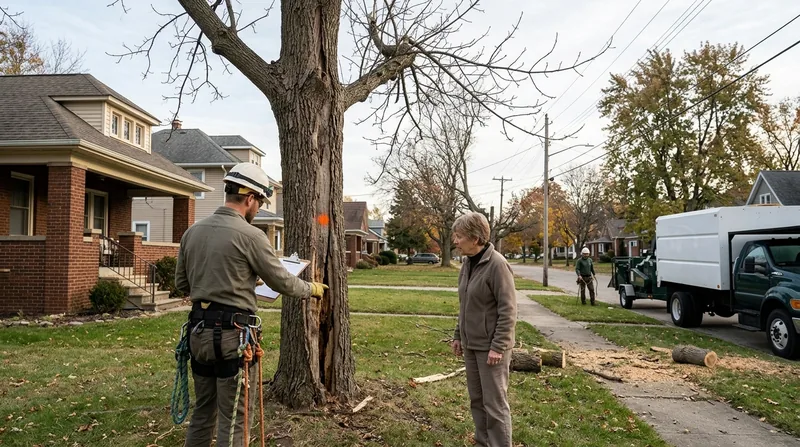




South Bend's tree canopy tells the story of a century of growth. From the Victorian mansions of West Washington to the brick bungalows near Notre Dame, and out to the newer subdivisions in Granger and Mishawaka, mature trees line streets and shade yards across the region. Many of these trees, especially the silver maples, red oaks, and American elms that dominate the landscape, face real stress from lake-effect snow loads, ice damage, and disease. An arborist consultation in South Bend gives you a clear, professional assessment of what your trees need to stay healthy, what hazards they pose, and what action makes sense for your property. We combine field expertise with written reports that hold up for permits, insurance claims, and long-term planning. Whether you're managing a heritage oak in a historic district or concerned about a diseased ash near your foundation, a consultation is the first step to making the right call.
Why Tree Assessment Matters in South Bend's Heavy Snow and Ice Climate
South Bend winters bring serious weight to branches. Lake-effect snow off Michigan, combined with the region's glacial terrain and aging tree stock, creates ideal conditions for branch failure, limb breakage, and full tree collapse. Many properties carry multiple hazard trees without knowing it, and a single heavy wet snow or ice storm can turn a liability into an emergency. A professional arborist assessment identifies which trees will shed limbs, which are diseased or structurally unsound, and which pose a genuine threat to your home, garage, fence, or power lines.
- We identify branch failure risk before winter storms arrive and cause damage.
- We spot disease, decay, and structural defects that weaken trees and shorten their lifespan.
- We assess proximity to your roof, deck, foundation, and overhead utility lines.
- We provide written documentation for insurance carriers and permit applications.
- We recommend preventive pruning, removal, or monitoring based on actual risk, not guesswork.
A consultation protects your property and gives you peace of mind when the next nor'easter rolls through.
Key info: South Bend's heavy snow and ice loads cause more tree failure than wind or disease alone. A Granger homeowner with two large silver maples over the roof avoided a $12,000 removal after we identified early crown damage and recommended targeted pruning instead. Early assessment saves money and prevents emergencies.
For more on managing hazard trees before they fail, see our emergency tree service page.
How We Conduct an Arborist Consultation in South Bend
Our process is straightforward and thorough. We arrive on-site, examine each tree in detail, note its species, age, structural condition, and proximity to buildings and utilities. We check for signs of disease, pest damage, decay, and branch defects. We measure trunk diameter and crown spread. We take photos and notes, then walk you through our findings and recommendations in plain language. You get a written report that details what we found, what we recommend, and why. That report becomes your reference for decisions about pruning, removal, or ongoing care.
- We inspect the full tree crown, trunk, base, and root collar for signs of stress or damage.
- We assess tree species and age to understand its growth pattern and typical lifespan.
- We measure proximity to structures, utilities, and property lines to identify conflict zones.
- We evaluate soil compaction, root girdling, and site conditions that affect tree health.
- We document all findings and deliver a written report with photos and clear recommendations.
You leave with a clear roadmap and the confidence to make informed decisions about your trees.
Local example: A homeowner in South Bend's Chapin Park historic district needed to know whether a 60-year-old red oak was safe to keep near the house. Our consultation identified early decay in the main crotch, ruled out removal (the tree had heritage protection), and recommended cable bracing and pruning to extend its life another 15-20 years. The written report satisfied both the HOA and the property owner's insurance carrier.
If your situation involves multiple trees or complex decisions about pruning and maintenance, we can connect those findings to a care plan.
Consultation Methods and Approaches
| Approach | Description | Best for |
|---|---|---|
| Visual Crown Assessment | Ground-level inspection of branch structure, foliage color and density, deadwood, and crown shape. | Routine health checks, disease spotting, hazard identification on most residential properties. |
| Trunk and Root Collar Exam | Close inspection of bark, wounds, cavities, root girdling, soil compaction, and base stability. | Detecting decay, structural weakness, or poor planting that shortens tree life or increases failure risk. |
| Proximity and Conflict Mapping | Measurement of distance to house, deck, garage, fence, power lines, and property lines with photo documentation. | Determining removal urgency, permit requirements, HOA issues, and insurance liability. |
| Species and Age Analysis | Identification of tree species, ring count or age estimate, and expected growth pattern and maturity. | Planning long-term property management, identifying invasive or weak-wooded species, and heritage tree status. |
| Written Report with Recommendations | Detailed findings, photos, tree inventory, risk assessment, and actionable next steps for care or removal. | Permit applications, insurance claims, HOA approval, and property owner decision-making and planning. |
Arborist Consultation Cost in South Bend: What to Expect
An arborist consultation cost in South Bend typically starts at $95 for a basic single-tree assessment on an easily accessible property. The fee covers a thorough visual inspection, basic measurements, species identification, and a verbal summary. If you need a written report with photos and detailed recommendations (required for most permits and insurance claims), expect to invest $150 to $300 depending on the number of trees, property size, and complexity of your situation. A large multi-tree property with hazard mapping and detailed structural analysis can run $400 to $600 or more.
Several factors drive the final number. Large trees over 60 feet tall require more time and sometimes climbing equipment to assess safely. Diseased or structurally compromised trees demand closer inspection. Trees near buildings, utilities, or property lines require precise measurements and photo documentation. Historic or protected trees in neighborhoods like West Washington or Chapin Park often need extra detail for HOA or permit review. Access also matters: a tree on a steep slope or surrounded by fencing costs more to assess than one in an open yard.
The smartest move is to get two or three estimates from different contractors. You'll see consistency in findings and can compare approach and pricing. Our estimate is free, and we respond within 24 hours. Call (219) 291-3724 with a description of your trees and what's driving your concern, and we'll give you a ballpark figure over the phone. For precise pricing tailored to your property, visit our full pricing page.
What to Look for When Hiring an Arborist Near Me in South Bend
Hiring the right arborist makes the difference between a consultation that sits in a drawer and one that actually protects your property and saves you money. Start by verifying that the company is fully insured in Indiana. Ask for proof of general liability and workers' compensation coverage. A experienced arborist has training in tree biology, hazard assessment, and safe work practices. Check references from recent South Bend or Mishawaka jobs. Ask to see sample reports from similar properties so you know what you'll receive. Get multiple estimates before deciding, and don't automatically choose the lowest bid; the cheapest consultation is worthless if it misses hazards or doesn't hold up for permits.
Understand your local rules before you hire. South Bend and surrounding cities like Osceola and Granger have tree removal permits for trees above a certain diameter. Protected heritage trees (many oaks and elms in historic districts) require city or HOA approval before removal. If you're in a neighborhood with an HOA or live in a historic district, confirm that the arborist is familiar with those requirements and can provide documentation that satisfies your approval process. Ask whether the report will be acceptable for your insurance carrier or permit application.
Finally, choose someone who will explain findings in plain language and answer your questions. A good consultation is a conversation, not a one-way report. You should leave understanding what your trees need and why. Ready to move forward? Contact us for a free, no-obligation estimate and to discuss your trees with an experienced arborist.
Arborist Consultation in South Bend: Pricing Guide
| Service | Price | Details |
|---|---|---|
| Single-tree visual assessment | Starting at $95 | Ground inspection, species ID, and verbal summary for one tree on accessible property with no complications |
| Written report with photos and recommendations | Starting at $150 | Detailed findings, measurements, risk assessment, and action plan suitable for permits, insurance, or HOA review |
| Multi-tree property or complex site assessment | $300 to $600 | Full inventory, hazard mapping, proximity analysis, and recommendations for multiple trees or large acreage with detailed documentation |
| Heritage or protected tree consultation | $200 to $400 | Specialized assessment for historic district or HOA-regulated trees requiring detailed structural analysis and compliance documentation |
| Travel and scheduling | Included | No mileage fee or travel charge for South Bend, Mishawaka, Granger, Osceola, and surrounding service area locations |
| Free estimate by phone or email | Free | Response within 24 hours at (219) 291-3724 with ballpark figure based on your description and property details |
Indicative pricing, the exact cost depends on square footage, finish, and site access. Free personalized estimate within 24h at (219) 291-3724.


